
Fairfax County Bench Warrants Explained
A bench warrant is a court order that grows out of a case already on the docket, usually a missed court duty. Fairfax County lists the common triggers: skipped criminal and traffic dates, failure to answer a summons or warrant, contempt, and certain bond or supervised-release violations. A felony matter may run through Circuit Court. Many adult traffic and misdemeanor cases start in General District Court instead. "Failure to appear" is simply the label for the missed obligation. "Capias" is the formal arrest process, used especially after a felony indictment, and Fairfax GDC procedures apply a "capias warrant of arrest" to some failures to appear. Family and juvenile cases move through JDR procedures, where public records are restricted.
Traffic Infractions and Criminal Summonses Differ
Fairfax GDC draws a sharp line between a traffic infraction and a criminal summons. Under the infraction procedure, the court may try the matter in your absence and add a $35 trial-in-absence fee. That rule does not say every missed traffic date turns into an arrest warrant. Misdemeanor cases run differently. If you fail to appear on a Class One or Two misdemeanor summons, the court can continue the case and direct a capias warrant of arrest. Ignoring an existing warrant can bring the same result plus a bond-forfeiture notice. So one missed date does not fit all charges in Fairfax County. Confirm the exact charge and process with the clerk instead of guessing. The distinction comes straight from Fairfax County GDC's administrative procedures.
How Fairfax County Bench Warrants Are Issued
A judge signs the warrant inside the case that was already pending, after a missed setting or another failure to comply. In the listed GDC circumstances, the clerk is directed to issue capias process. That is what separates it from a new probable-cause arrest warrant for an alleged offense, which starts a case rather than enforcing one. After issuance, the court record and the service channels must be checked separately. Fairfax County publishes no public criminal active-warrant roster and sets no update schedule. The Sheriff's Warrant Desk can help you identify the issuing court, while the clerk controls the docket and motion instructions. Ask for your next court date and the court's current filing requirements. The clerk can explain procedure but cannot give legal advice.
Fairfax GDC’s Capias Procedure
The local GDC procedure shows why charge type matters so much. For a qualifying misdemeanor summons, a missed appearance may produce a capias warrant of arrest. In the separate traffic-infraction example, the court may try the case in absence and add the stated fee. When a person fails to respond to an existing criminal warrant, the court can direct a capias along with a bond-forfeiture notice. These are procedure descriptions, not promises about any one Fairfax County file. A citation, a criminal summons, a probation matter, and an indictment may each travel a different route. Confirm your case type with the Criminal Clerk at 703-246-3305 or the Traffic Clerk at 703-246-2815.
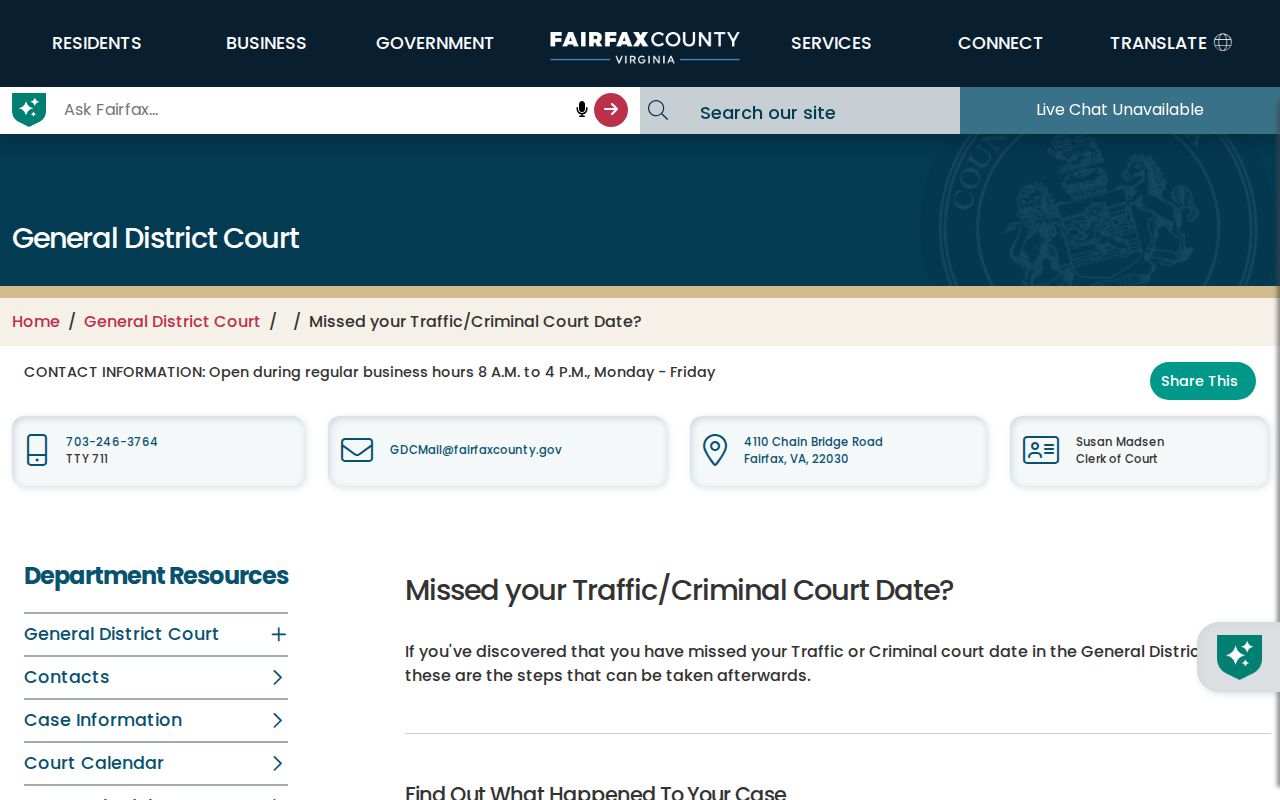
Fairfax County GDC names the remedy on its official page: a Motion to Withdraw the Bench Warrant or Failure to Appear Warrant.
Bench Warrants and Arrest Warrants Compared
Both orders can end in arrest, but they start differently. A Fairfax County bench warrant follows a court obligation in an existing case. An arrest warrant begins with a criminal complaint and a probable-cause review. That distinction decides which clerk to call and which motion or appearance you may need.
| Point | Bench or FTA | Arrest Warrant |
|---|---|---|
| Trigger | Missed setting or court noncompliance | Complaint and probable cause |
| Underlying case | Usually already pending | May precede a first appearance |
| Issuing route | Judge handling that court case | Magistrate or authorized judicial officer |
| Confirmation | Issuing clerk and Sheriff | Warrant Desk and issuing authority |
For the probable-cause route, see the Fairfax County arrest warrant information.
Fairfax County Motion to Withdraw Process
If Fairfax GDC tells you a missed-date warrant was authorized, the official next step is a Motion to Withdraw the Bench Warrant or Failure to Appear Warrant, filed with the Criminal or Traffic Clerk. The court says to act as soon as possible and ask that the motion be docketed promptly, the next court day if possible. No fillable motion form is published, and the court has not confirmed that this motion can always be filed by email. Have a lawyer? Contact counsel first. If you were released on surety bond or supervised release, notify the bonding company or counselor right away. If you cannot afford counsel, the court's missed-date instructions say to ask about an indigency interview or appointed counsel at the motion setting in Fairfax County.
Resolving a Fairfax County Bench Warrant
Follow the steps in order, since paying a case is not the same as a court order. The issuing judge controls withdrawal in Fairfax County. The Sheriff can confirm a warrant channel or give service instructions.
- Call the Sheriff’s Warrant Desk and the clerk to confirm the issuing court, case number, status, and next step.
- For a county GDC missed date, contact Criminal or Traffic and ask how to submit the withdrawal motion.
- Tell counsel or the bonding company if a release condition was involved.
- Appear on the scheduled motion date or follow the clerk’s written direction.
- Keep the signed order and ask the clerk how to confirm the warrant is withdrawn.
Caution: Do not wait for a web result to change. A motion remains undecided until the court acts, and an open warrant may be served.
What Bond Forfeiture Means in Fairfax
Bond is money or a condition backing a promised court date. Skip the date, and the court may take the security. Notice comes first, and a judge can excuse the loss for good cause. Fairfax GDC's stated procedure goes further in one spot. It says cash bond may be forfeited without further notice in a listed failure-to-respond situation. Amounts and conditions stay case-specific. Fairfax County publishes no countywide warrant-bond schedule. Arrest changes things. The magistrate then holds a bail hearing or commits the person under Virginia procedure. Fairfax County magistrates sit at the Adult Detention Center. The ADC phone tree routes calls on bonds, release dates, and court dates, so call first for current intake and payment instructions. A magistrate can explain the bail process but gives no legal advice. The Magistrate’s Office page lists duties and local service locations.
Finding the Court That Issued the Warrant
Fairfax County GDC hears adult traffic and misdemeanor cases, with divisions at the courthouse, Herndon, and Vienna. The City of Fairfax keeps its own clerk and payment system. Circuit Court handles felonies, indictments, and appeals. JDR handles juvenile and family cases. Unsure which court issued the warrant? For a Fairfax County case, call GDC Criminal at 703-246-3305 or Traffic at 703-246-2815. The automated case and payment line is 703-246-3764. For a City of Fairfax case, call 703-385-7866. If the locality is unclear, the Fairfax County Warrant Desk at 703-246-4231 can steer the question. The GDC contact table lists the divisions.
JDR Warrants Have Restricted Records
Juvenile and domestic-relations cases skip the public route an adult traffic matter uses. Virginia’s online case information gives no JDR details. State law also limits who may see juvenile law-enforcement and court records. A person with legal authority should ask the JDR clerk what proof or procedure is required. A blank online search does not mean no JDR process exists. For a Fairfax County case, call the JDR clerk. The clerk’s number is 703-246-2335. Worried an arrest warrant exists but the issuing court is unknown? The Fairfax County Sheriff’s Warrant Desk can help.